
In the landscape of non-surgical facial rejuvenation, High-Intensity Focused Ultrasound (HIFU) stands unique as the only technology capable of targeting the SMAS (Superficial Muscular Aponeurotic System)—the same tissue layer addressed in a surgical facelift. For medical practitioners, the success of a HIFU treatment is not just about the “before and after” photo; it is about the clinical precision of energy delivery and the biological response it triggers.
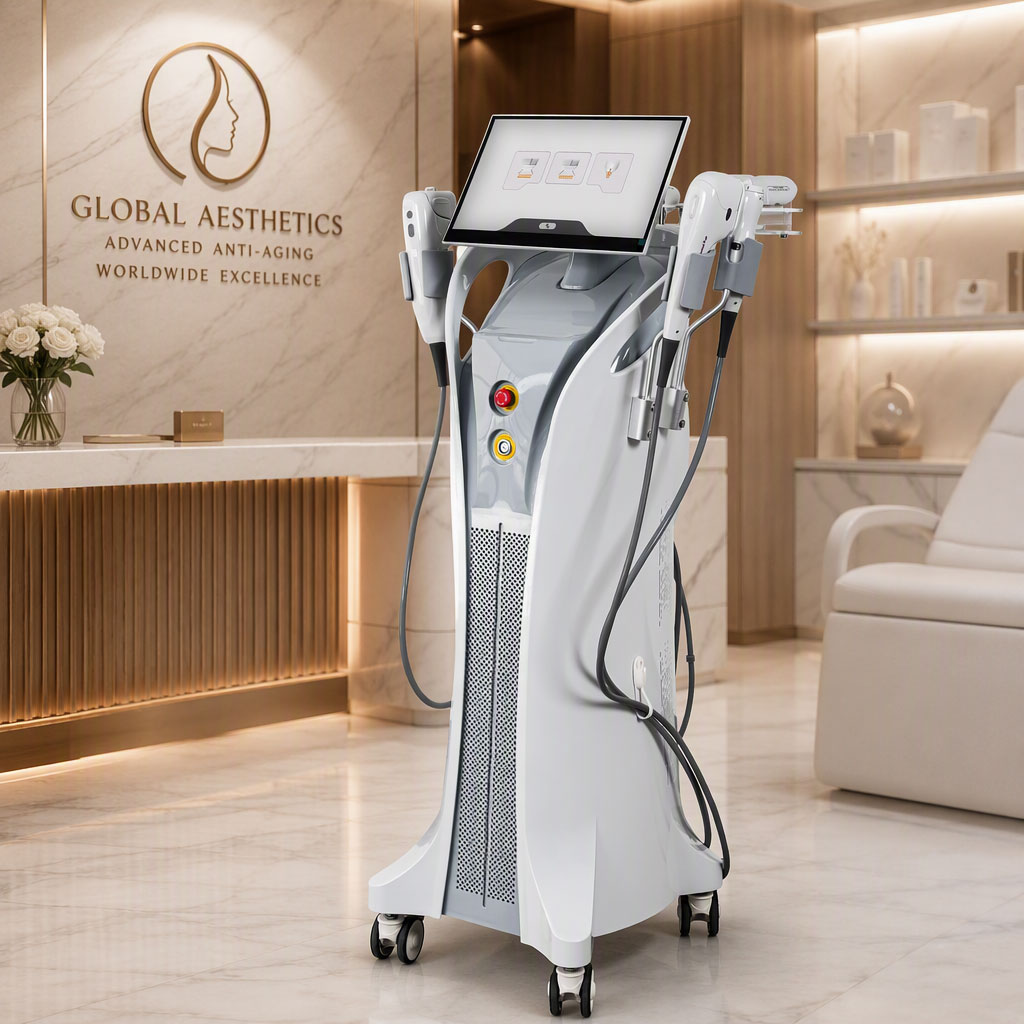
The Mechanism: Thermal Coagulation Points (TCPs)
The clinical efficacy of HIFU relies on its ability to bypass the skin’s surface and deliver concentrated ultrasonic energy at specific depths. This creates Thermal Coagulation Points (TCPs) where temperatures reach between 60°C and 70°C. At this precise range, collagen denaturation occurs, followed by a wound-healing response that stimulates the synthesis of new, high-quality collagen and elastin. At JONTELASER, our R&D focus is ensuring that these TCPs are uniform in size and perfectly spaced to maximize lifting while preserving surrounding healthy tissue.
Depth Precision: The Key to Clinical Success
A one-size-fits-all approach does not work in medical aesthetics. Successful clinical outcomes require multi-depth targeting:
- 4.5mm Transducers: These are critical for targeting the SMAS layer to achieve structural lifting.
- 3.0mm Transducers: These target the deep dermis to address fat volume and skin density.
- 1.5mm Transducers: These are used for superficial dermis rejuvenation, improving skin texture and fine lines. The clinical challenge with many lower-tier machines is “depth drift”—where the energy does not reach the intended layer accurately. JONTELASER’s HIFU systems are calibrated for absolute depth accuracy, ensuring that practitioners hit the SMAS every time without risk to deeper structures or the epidermis.
Clinical Safety: Managing the “Hot Spot” Risk
From a clinical safety standpoint, the most significant risk in HIFU treatments is unstable energy output, which can lead to “hot spots” and potential nerve injury or surface burns. Clinical stability is where JONTELASER excels. Our devices are engineered with advanced cooling and energy-regulating sensors that maintain a consistent pulse. This allows the doctor to focus on the patient’s anatomy and comfort rather than worrying about machine volatility.
Patient Comfort and Long-term Consistency
Clinically, patient comfort is directly tied to the speed and precision of the ultrasonic wave. A cleaner, faster pulse reduces the perception of pain while achieving the required thermal threshold for collagenesis. Furthermore, for a clinic to build a brand, results must be repeatable. A stable device ensures that the clinical result achieved for the first patient is identical to that of the hundredth, which is essential for patient retention and referral.
Conclusion: Empowering the Practitioner
At JONTELASER, our philosophy is to provide doctors with a reliable “clinical tool” rather than just a piece of hardware. By providing clear clinical parameter suggestions and equipment that doesn’t skip a pulse, we empower practitioners to deliver the “Gold Standard” in non-invasive lifting. As we often say: “Safety and clinical results are the only paths to a clinic’s long-term success.”