Quick Answers
- Is hirsutism the same as excess hair? No. Hirsutism is coarse, dark hair growing in a male pattern on a woman’s face, chest, abdomen or back, and it usually has an androgen driver. Excess fine hair (hypertrichosis) is a different complaint with different expectations.
- Can a diode laser treat hirsutism? Yes, it can reduce the hair, but it does not treat the hormonal cause. The device removes pigment-bearing follicles; it does not change circulating androgens.
- Is the result permanent? Permanent reduction is the defensible claim. Hormonally stimulated follicles can reactivate, so maintenance sessions are part of the plan, not a sign of failure.
- When should a clinic refer instead of treating? Sudden onset, rapid progression, signs of virilisation, or growth that appears after years of stability warrant endocrine assessment before or alongside treatment.
- What does this patient group demand from a device? Cooling that stays effective over long sessions, a spot size that covers the face and neck efficiently, and documented settings that can be reproduced visit after visit.
What Hirsutism Is, and Why the Distinction Matters Commercially
Hirsutism describes terminal hair that appears where a male pattern would place it — upper lip, chin, jawline, sideburns, sternum, linea alba, upper back — in a patient who does not otherwise expect hair there. The clinical definition rests on hair type and distribution, not on quantity alone. A woman with dense but fine vellus hair across the cheeks has a cosmetic concern; a woman with a dozen thick dark hairs on the chin has a sign that may have an endocrine explanation.
For a clinic, that distinction is not academic. It determines the consultation script, the consent language, the session calendar, the price architecture, and the referral behaviour of your team. It also determines whether the patient leaves satisfied: someone expecting a permanent cure will measure the service against an impossible standard.
Why Hormonally Driven Hair Behaves Differently Under Laser Light
Diode laser hair removal works by selective photothermolysis. Light in the 755–1064 nm range is absorbed preferentially by melanin in the hair shaft and follicle, converted to heat, and used to damage the structures responsible for regrowth. Three practical consequences follow, and all three matter more in hirsutism than in routine cosmetic cases.
Growth phase limits each session. Only follicles in the anagen (growth) phase are vulnerable in a meaningful way. Because follicles cycle independently, a single session can only reach the proportion that happens to be active at that moment. This is why courses are spaced weeks apart rather than delivered back to back.
Androgens keep re-priming follicles. In a patient with an ongoing androgen drive, follicles that were suppressed can be recruited back into a thick, dark, terminal state. The laser is not failing; the biology upstream is still running. This is the single most important expectation to set before the first pulse.
Hair density changes the energy picture. Dense, coarse hair on the chin and upper lip absorbs strongly, which is favourable for efficacy but unforgiving on the epidermal side. That combination — high target absorption, thin delicate skin, sometimes a darker baseline skin tone — is exactly where cooling discipline and conservative parameter escalation decide whether you get a good outcome or a pigmentary event.
The Four Presentations You Will Meet at Consultation
Most hirsutism enquiries slot into one of four patterns. Naming the pattern out loud, in front of the patient, is a useful consultation technique because it makes the plan feel considered rather than generic.
- Stable, long-established, limited distribution. A few coarse hairs on the chin or upper lip, unchanged for years, no other symptoms. Straightforward treatment candidate; short course, then maintenance.
- Progressive with systemic signs. Growth spreading over months, alongside acne, irregular cycles, weight change or hair thinning on the scalp. Treat only with a referral in place, and expect the medical workup to change the trajectory.
- Post-menopausal or post-medication onset. New terminal hair after a hormonal shift or a change in medication. Often responds well, but the trigger should be documented and, where relevant, discussed with the prescribing clinician.
- Post-treatment recurrence. Hair returning after previous laser courses elsewhere, sometimes finer and lighter, sometimes unchanged. Assess honestly: light fine regrowth is a poor laser target and a good candidate for a different modality.
Screening Boundaries: When to Refer Before Treating
A laser clinic is not an endocrine service, and pretending otherwise creates clinical and reputational risk. The safe operating rule is simple: treat the hair, but route the driver. Refer — or require that the patient has already been assessed — when any of the following appear.
- Onset that is sudden rather than gradual, or progression that is rapid over a short period.
- Virilising features: voice change, clitoromegaly, male-pattern balding, significant muscle or fat redistribution.
- Hirsutism accompanied by menstrual irregularity, infertility, or a recent diagnosis the patient is still being worked up for.
- Onset in childhood or early adolescence, or growth that began before puberty completed.
- Rapidly changing pigmented lesions, or skin disease in the treatment area that is active and unexplained.
Document the referral in the record, and make clear that laser can run in parallel with a workup where the treating clinician is comfortable. The cosmetic burden is real; the patient still needs an option.
Setting Outcomes Without Promising a Cure
The honest framing is a reduction range plus a maintenance rhythm. Coarse dark terminal hair on light skin responds best; fine light hair responds poorly and should be identified before payment rather than after. A patient should leave the consultation able to repeat three sentences back to you: the hair will get thinner and sparser rather than disappear permanently; the number of sessions is a plan with a review point, not a guarantee; and if the hormonal driver remains active, top-up sessions will be needed to hold the result.
Avoid quoting fixed percentages for clearance. Figures vary with device, parameters, skin and hair type, operator technique, interval and endocrine status; transplanting a number from another clinic’s study into your consultation is how disputes start. Photographic baseline documentation under consistent lighting, at the same angle and distance each visit, is worth more than any quoted statistic.
Session Architecture: Interval, Density and Maintenance
Hirsutism plans differ from standard body work: the areas are small and awkward, the skin is sensitive, and the endpoint is a stable maintenance state rather than a finish line.
- Interval. Spacing is set by the hair growth cycle in the treated area and by the patient’s tolerance, not by a fixed calendar applied to every patient. Facial hair cycles faster than body hair, so facial courses usually need tighter spacing than legs or back.
- Coverage. Treat the whole affected field rather than visible hairs only. Spot-treating individual hairs produces a patchy result and an unpredictable maintenance pattern.
- Escalation. Start conservatively and increase only when the previous session produced a clear response with no adverse pigmentary change. In darker skin tones this discipline is not optional.
- Review point. Build an explicit assessment visit into the course — a defined number of sessions after which you compare photographs, discuss remaining density, and decide whether to continue, switch modality, or move to maintenance.
- Maintenance. Offer a scheduled maintenance interval rather than an open-ended “come back when you need it”. Predictable maintenance is better clinically and commercially, and it prevents the patient from interpreting normal reactivation as a failed purchase.
Laser vs. IPL vs. Electrolysis vs. Temporary Methods
Patients arrive having read comparisons that flatten important differences. Use this as a consultation aid, not a claim of superiority in every case.
| Method | How it works | Best fit in a hirsutism case | Practical limits |
|---|---|---|---|
| Diode laser (755/808/940/1064 nm) | Selective photothermolysis of melanin in the follicle | Dense, coarse, dark terminal hair over larger facial or body fields | Poor target for fine light hair; needs cooling discipline; maintenance required if androgens persist |
| IPL | Broadband filtered light, scattered rather than focused | Mild cases where a lower-intensity option is preferred | Less selective, generally fewer durable results on coarse hair, more operator-dependent |
| Electrolysis | Chemical destruction of each follicle with a probe | Light, fine or grey hair that laser cannot target; small isolated areas | Slow, operator-intensive, uncomfortable; impractical for large fields |
| Shaving, waxing, threading, depilatory creams | Mechanical or chemical removal above the follicle | Bridging between sessions; patients not ready for a course | No effect on the follicle; ingrown hair and irritation risk with frequent waxing |
For the classic hirsutism patient — coarse dark hair, defined facial distribution, possible ongoing androgen drive — a diode platform is the workhorse. Electrolysis remains the honest answer for fine light hair that laser will never clear.
Equipment Requirements for a Hirsutism-Focused Service
Not every diode platform is suited to this patient mix, and the differences show up in month three rather than on the spec sheet.
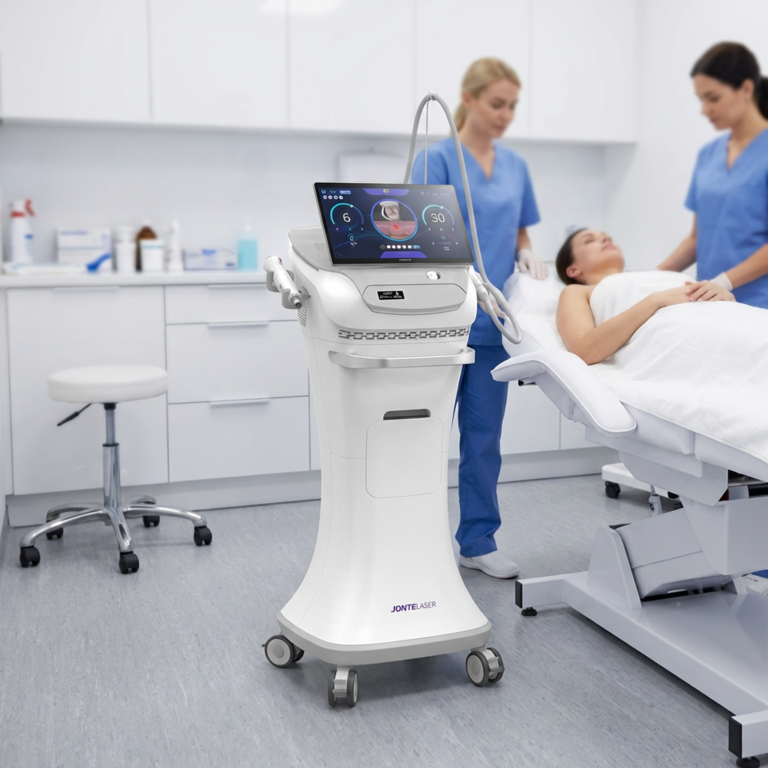
- Cooling that holds up over long sessions. Facial work means many pulses over small areas with thin skin. Semiconductor (TEC) cooling integrated into the handpiece is what allows a full face-and-neck session to finish without the operator rationing energy to keep the patient comfortable.
- Wavelength coverage across skin types. Multi-wavelength platforms in the 755/808/940/1064 nm range let one device serve lighter and darker Fitzpatrick types and different hair depths, which matters because hirsutism presents across the whole skin-type spectrum.
- Power headroom in 1200 W and 1800 W configurations. Higher-power configurations give the operator room to maintain fluence at a workable repetition rate instead of trading efficacy for speed.
- Reproducible settings. Stored treatment records and a clear parameter display make it possible to repeat a good session exactly, which is what makes a photographic review meaningful.
- Spot size and handpiece ergonomics. Small areas need precision; if the same platform also serves body work, the handpiece range should cover both without forcing a second machine.
Consumables, Throughput and the Economics of a Maintenance-Driven Service
A hirsutism service is not a one-off transaction, and pricing it like a single-session treatment is the most common commercial mistake. Three structural points follow from the clinical reality described above.
- Price the course and the maintenance separately. Bundling maintenance into the initial course hides the real cost of a long-term relationship and removes the incentive to keep the patient on schedule.
- Model throughput on realistic session length. A full face and neck is a different operational load from a pair of underarms. Book accordingly, or the schedule collapses the first time two hirsutism patients land on the same afternoon.
- Account for consumables per session, not per patient. Gel, protective eyewear, aftercare and any single-use interface items scale with visits, so a maintenance patient costs more per year than a one-off case.
Where the platform offers consumable-light operation, that directly improves the economics of a maintenance-heavy service line, because margin is earned on repeat visits rather than on a single high-value sale.
Certification, Evidence and Manufacturer Due Diligence
Hirsutism patients are often the most medically literate patients in an aesthetic clinic: many have already seen an endocrinologist, read about their condition, and will ask what standards the equipment meets. A manufacturer should be able to answer that without hesitation.
- ISO 13485 certification for the quality management system covering design and manufacture.
- MDSAP audit coverage, which indicates the quality system has been assessed against multiple regulatory jurisdictions in a single programme.
- Documentation aligned to CE, FDA and TGA frameworks — with the clear understanding that the specific cleared indications and the claims a clinic may legally make depend on the registration status in the clinic’s own market.
- A manufacturing track record. Beijing JONTELASER Technology Co., Ltd. has been building aesthetic laser and energy devices since 2004 and exports to more than 50 countries.
- Operator training and after-sales support, including parameter guidance for different skin types — the part that actually determines outcomes in a hirsutism-heavy patient mix.
Working With JT MED on a Hirsutism-Capable Platform
JT MED supplies multi-wavelength diode laser hair removal platforms in 755/808/940/1064 nm configurations with 1200 W and 1800 W options, built by Beijing JONTELASER Technology Co., Ltd. under ISO 13485 and MDSAP-audited quality systems, with documentation aligned to CE, FDA and TGA frameworks. OEM/ODM programmes, operator training and marketing support are available for distributors and clinic groups building a dedicated hair-reduction service line. Request the current catalogue and a quotation from the JT MED export team, specifying your target patient mix, skin-type distribution and expected session volume so the configuration recommendation matches your caseload rather than a generic specification.
FAQ for Clinic Owners and Practitioners
Does laser cure hirsutism? No. Laser reduces hair by damaging pigment-bearing follicles. Hirsutism has an upstream driver, usually hormonal, that laser does not address. Treatment is best positioned as hair reduction combined with maintenance, alongside whatever medical management the patient’s clinician recommends.
How many sessions should I quote? Quote a course with a defined review point rather than a fixed total. The number depends on area, hair type, skin type, device and endocrine status, and it should be revised after the photographic comparison at the review visit.
Can I treat a patient who is still awaiting an endocrine workup? Often yes, provided the presentation carries no virilising features and the referral is documented. Sudden onset, rapid progression or virilisation should pause treatment until the patient has been assessed.
What if the patient is on hormonal medication? Record it, and set expectations that the trajectory may change if the medication changes. Coordinate with the prescribing clinician where the patient is willing; do not adjust or advise on that medication yourself.
Why does the hair come back after a good result? Because follicles that were suppressed can be re-recruited into a terminal state while an androgen drive continues. This is reactivation, not treatment failure, and it is the reason maintenance is designed into the plan from the start.
Is diode laser safe on darker skin tones? It can be, with adequate cooling and conservative parameter selection, and 1064 nm is generally the more forgiving wavelength as epidermal melanin absorption falls. The operator must still assess each patient individually and escalate only on evidence of a clean response.
What about fine or light-coloured regrowth? Laser needs a pigmented target. Fine, light or grey hair is a poor candidate and should be redirected to electrolysis or accepted as a limit of the modality. Saying this at consultation protects the clinic later.
How should I handle a patient who has been treated elsewhere without success? Ask what device, interval and parameters were used, then look at the current hair. Coarse dark regrowth may still respond to a properly spaced course; fine light regrowth should be redirected.
Do I need a different device for facial versus body work? Not necessarily. A platform with a suitable handpiece range and stable cooling can cover both, though a dedicated small spot size improves precision on the upper lip and chin.
What documentation should I keep? Baseline and review photographs under consistent conditions, the parameter set used at each visit, the areas treated, any referral made, and the maintenance schedule agreed with the patient.