
Direct answer: Instant skin tightening with HIFU is real — it happens because focused ultrasound thermally denatures collagen in the deep dermis and SMAS layer the moment each pulse lands, causing the tissue to contract immediately. The latest generation of HIFU machines makes this “instant” effect more reliable, more comfortable, and faster to deliver through four upgrades: real-time ultrasound visualization (MFU-V), multi-depth transducers fired in one session, higher-power emitters that shorten treatment time, and hybrid platforms that pair HIFU with radiofrequency or other modalities. The protocol that actually produces instant tightening is simple in principle — map the tissue, choose the right depth and energy density, and deliver a layered 1.5/3.0/4.5mm pass — but the visible outcome is only half the story: the immediate contraction is followed by months of progressive collagen remodeling that turns a quick tightening into a lasting lift.
The “Instant” Mechanism: What Happens in the First Seconds
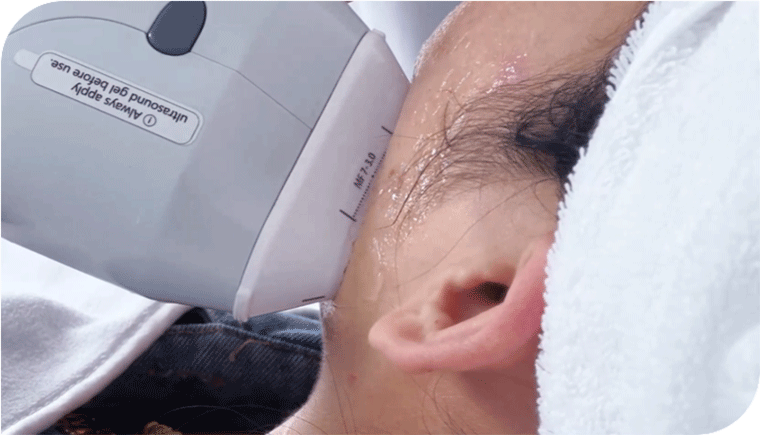
The instant tightening effect is not marketing language — it is a physical event. When a focused ultrasound pulse reaches its focal point, tissue temperature rises to 60–70°C in under a second. At that temperature, collagen undergoes thermal denaturation: the triple-helix structure of the collagen fibrils unwinds and shrinks — the same protein-shortening reaction that contracts tissue in the first seconds of any heat-based tightening, but delivered here at a precise, confined depth.
The foundational proof of this mechanism comes from the original intense-focused-ultrasound evaluation (Laubach et al., 2008): using a 7.5MHz prototype with a 4.2mm focal distance, researchers created individual, highly confined thermal lesions up to 4mm deep in the dermis, with a precise, reproducible grid pattern — inverted-cone-shaped micro-coagulation zones. That study established the two facts every modern HIFU machine builds on:
- Spatial confinement — damage occurs only at the focal point; the epidermis and upper dermis are untouched (which is why there is no downtime and no surface injury).
- Precision — lesion depth and size are controlled by the exposure parameters, so a practitioner can place tightening exactly where the laxity is.
Immediately after treatment, the visible effect comes from two sources at once: the contraction of the denatured collagen in the treated zone, and the mild, transient tissue edema that plumps the skin. That is the “instant tightening” patients see in the mirror on day one.
What “Latest Generation” Actually Adds
The physics has not changed since 2008 — the engineering around it has. Here is what the current generation of HIFU machines improves:
| Technology generation | Early HIFU (2008–2014) | Latest generation (2023+) | What it changes for the patient |
|---|---|---|---|
| Depth targeting | Fixed transducer, single depth per cartridge | Interchangeable multi-depth cartridges (1.5 / 2.0 / 3.0 / 4.5mm+), multi-pass in one session | Full-thickness tightening from one visit |
| Visualization | Blind or landmark-based placement | MFU-V: real-time ultrasound imaging shows the exact tissue depth before each shot | Safer, more consistent results, especially on thin skin |
| Power & speed | ~45W prototypes, slow shots | Higher-power emitters and larger spot sizes; faster repetition rates | 30–90 min full-face treatments instead of longer sessions |
| Comfort | Noticeable prickling, no active cooling | Energy control curves, contact cooling, lower-pain profiles | Pain scores down; topical anesthetic often optional |
| Platform design | Single-purpose HIFU | Hybrid consoles: HIFU + RF (monopolar/bipolar) + facial/body heads | One machine sells a full tightening menu |
The two upgrades that matter most clinically are visualization and multi-depth capability. MFU-V removes the guesswork — the practitioner sees the SMAS and dermis on screen and delivers each shot to the intended layer, which is what protects the facial nerve zones and makes consistent results repeatable. Multi-depth capability lets a single session build the tightening from the inside out: 4.5mm for the SMAS lift, 3.0mm for deep dermal remodeling, 1.5mm for surface texture — the layered approach that head-to-head clinical data (600 shots at 3.0 and 4.5mm in the 2025 benchmark study) associate with strong sustained lifting at 3 months.
The Protocol: How to Get Instant Tightening from a Modern HIFU Session
A “How to” answer, step by step:
- Consult and contraindication screen. Exclude pregnancy, active skin infection, open wounds, and implanted electronic devices in the field. Set expectations: instant tightening now, progressive lift over 2–3 months.
- Map the tissue. With an MFU-V machine, scan the treatment area first and identify the SMAS depth, skin thickness, and danger zones (perioral and temporal facial nerve branches). Mark the grid.
- Select depths and energy. Standard facial protocol: 4.5mm pass over the jawline, cheeks, and brow for the structural lift; 3.0mm pass for mid-dermal tightening; optional 1.5mm pass for fine lines. Energy density (number of lines and shots per zone) is scaled to skin thickness and laxity — thinner skin and periorbital areas get conservative settings.
- Deliver the layered pass. Each shot takes a fraction of a second. A full face typically runs 400–800 shots (the 2025 comparative study used 600) over 30–60 minutes. Comfort during treatment: a warm prickling sensation; topical anesthetic or oral analgesic if needed — published pain scores average around 4–5/10.
- Post-treatment. Expect mild redness and slight swelling for a few hours — this transient edema actually contributes to the immediate visible plumping. No downtime, no bandages; patients can return to normal activity the same day.
- Follow up. The primary result is usually achieved in one session. A second pass at 3–6 months is used for areas of significant laxity; annual touch-ups maintain the lift.
What “Instant” Really Means — the Honest Timeline
| Time point | What the patient sees |
|---|---|
| Day 0 (immediate) | Visible tightening from collagen contraction + mild edema; skin feels firmer |
| Week 1–2 | Swelling resolves; some tightening persists, skin texture improves |
| Month 2–3 | Peak result — new collagen and elastin have remodeled the tissue; the “lift” is fully visible |
| Month 12–18 | Results gradually fade with natural aging; touch-up session recommended |
The critical expectation to set: instant ≠ final. The day-one contraction is real but modest; the full value of the treatment compounds over 2–3 months as the wound-healing response lays down new collagen. This two-phase profile is why the best protocols — and the best clinical evidence — measure outcomes at 3 months, not 3 minutes.
Latest-Generation Combinations Worth Knowing
- HIFU + RF: the newest hybrid consoles fire focused ultrasound at depth and radiofrequency at the dermis in the same session — depth-targeted lift plus broad dermal heating for skin quality. The modalities complement each other: RF covers the diffuse collagen stimulation HIFU’s confined lesions don’t.
- HIFU + threads: some practitioners combine a 4.5mm HIFU pass with PDO threads for immediate mechanical suspension plus deep remodeling — useful for patients who want a visible jump on day one.
- HIFU + injectables: botulinum toxin (masseter, glabella) and dermal fillers pair naturally with HIFU, since the ultrasound lift addresses the structural layer while injectables handle volume and dynamic lines.
- HIFU + skin-care maintenance: retinol and antioxidant regimens between sessions support the remodeling phase.
Safety in the Latest Generation
The modern machine features that make “instant” safe: real-time visualization to avoid nerve territories, multi-depth cartridges so energy is never applied blind, and energy control curves that prevent over-dosing thin or sensitive skin. Published trials consistently report only mild, transient adverse effects (erythema, edema, occasional temporary numbness), and systematic reviews confirm high patient satisfaction. The serious risks — burns and facial nerve injury — are anatomical and protocol-driven: they occur when the wrong depth is used in the wrong zone, which is exactly what MFU-V and trained practitioners prevent.
FAQ
1. Is HIFU skin tightening really instant? Yes — visibly. Each pulse thermally denatures and contracts collagen at the focal point immediately, so patients see firmer skin right after the session. The full lift, however, develops progressively over 2–3 months as new collagen forms.
2. What is the latest HIFU technology? Current-generation machines combine micro-focused ultrasound with real-time visualization (MFU-V), interchangeable multi-depth transducers (1.5/3.0/4.5mm+) fired in one session, higher-power emitters for faster treatments, improved cooling and comfort controls, and hybrid consoles pairing HIFU with radiofrequency.
3. How many HIFU shots are needed for a full face? Typically 400–800 shots depending on area and protocol — the 2025 benchmark clinical study used 600 shots at 3.0 and 4.5mm depths for a full facial treatment.
4. Does HIFU tighten skin immediately or over time? Both. The immediate contraction is visible on day one; the lasting result comes from collagen remodeling that peaks at 2–3 months and can be maintained 12–18 months with touch-ups.
5. Is the latest HIFU painful? Less than early devices. Clinical trials report average pain around 4–5/10 — a warm prickling sensation per shot — with contact cooling and energy control reducing discomfort; topical anesthetics are used as needed.
6. Can HIFU replace a surgical facelift for instant results? No. HIFU gives an instant, non-invasive tightening and a progressive lift, but severe laxity still requires surgery. The honest framing: HIFU postpones surgery, maintains results afterward, and suits mild-to-moderate aging.
7. How long does one HIFU session take with new machines? 30–90 minutes for face and neck with latest-generation high-power heads; older or single-depth machines take longer.
8. Are results from the latest HIFU machines better than older ones? The physics is the same, but results are more consistent: visualization ensures correct depth every shot, multi-depth passes tighten more layers in one session, and higher power reduces treatment time — all of which translate to more reliable, reproducible outcomes.
Summary
Instant skin tightening with HIFU is a genuine physical effect: focused ultrasound contracts collagen at a precise depth the moment it fires, and the newest machines make that effect more predictable, faster, and more comfortable than ever — through MFU-V visualization, multi-depth single-session protocols, higher-power emitters, and hybrid RF platforms. The practical recipe is a layered 4.5/3.0/1.5mm pass, correct energy density per zone, and honest expectations: immediate tightening now, peak lift at 2–3 months, maintained with annual touch-ups. That combination — instant visible effect plus documented long-term remodeling — is why latest-generation HIFU remains the benchmark non-invasive tightening technology.
Sources
- Laubach HJ, et al. Intense focused ultrasound: evaluation of a new treatment modality for precise microcoagulation within the skin. Dermatol Surg. 2008. https://pubmed.ncbi.nlm.nih.gov/18429926/
- Comparative study: HIFU vs. microwave energy-based device for facial rejuvenation (600 shots at 3.0/4.5mm; sustained GAIS and elasticity gains at 3 months). Aesthet Surg J. 2025. https://pubmed.ncbi.nlm.nih.gov/41403025/
- Ling J, Zhao H. A systematic review and meta-analysis of the clinical efficacy and patients’ satisfaction of micro-focused ultrasound (MFU) treatment for facial rejuvenation and tightening. Aesthetic Plast Surg. 2023. https://pubmed.ncbi.nlm.nih.gov/37198297/
- Khan U, Khalid N. A systematic review of the clinical efficacy of micro-focused ultrasound treatment for skin rejuvenation and tightening. Cureus. 2021. https://pubmed.ncbi.nlm.nih.gov/35003992/
- Chen W, et al. Ultrasound rejuvenation for upper facial skin: a randomized blinded prospective study. J Cosmet Dermatol. 2024. https://pubmed.ncbi.nlm.nih.gov/39034504/
- Lou Y, et al. Efficacy and safety of micro-focused ultrasound for middle and lower face rejuvenation: a prospective study. Lasers Med Sci. 2026. https://pubmed.ncbi.nlm.nih.gov/41986762/