Quick Answers
- Which wavelength is used for dark skin? Longer wavelengths – 1064 nm and, in multi-wavelength platforms, 940 nm – penetrate deeper with lower melanin absorption in the epidermis, which widens the safety margin in higher Fitzpatrick types.
- What is 808 nm best for? The classic diode hair-removal wavelength. It balances melanin absorption with penetration depth and performs well across light to medium skin tones with dark hair.
- Why does 755 nm feel different? It is absorbed strongly by melanin, making it efficient on fine and lighter hair – but that same strong absorption on the skin surface makes epidermal cooling more critical.
- Does cooling affect which patients you can treat? Yes. Effective contact cooling protects the epidermis and is what allows a longer wavelength platform to be used safely and comfortably in darker skin types.
- Can one platform cover all skin types? A multi-wavelength platform lets a clinic address fair and deep skin tones in the same treatment room, rather than turning patients away or referring them out.
The Physics That Drives Wavelength Choice
Laser hair removal relies on selective photothermolysis: laser energy is absorbed by melanin in the hair shaft and follicle, converted to heat, and used to damage the follicular growth structures. The clinical difficulty is that melanin exists in two places – the target (hair follicle) and the obstacle (epidermis). The darker the skin, the more epidermal melanin competes for the same energy, and the narrower the margin between effective treatment and surface injury.
Three physical factors resolve this competition:
- Wavelength. Longer wavelengths scatter less and penetrate deeper, while being absorbed proportionally less by epidermal melanin. They trade a degree of absorption efficiency for a larger safety margin.
- Pulse duration. Extending the pulse allows heat to dissipate from the epidermis while the follicle, which is a larger target, retains enough thermal dose. Longer pulses are therefore the standard strategy in darker skin.
- Cooling. Contact cooling removes heat from the surface before, during, and after the pulse – the single most effective lever for treating higher Fitzpatrick types safely.
Wavelength by Wavelength: What Each Option Is For
| Wavelength | Absorption behaviour | Typical clinical role | Considerations |
|---|---|---|---|
| 755 nm | Strongest melanin absorption of the group | Fine hair, lighter hair colour, fair skin types; efficient energy transfer at lower fluence | Highest surface absorption – requires reliable cooling and careful parameter selection on darker skin |
| 808 nm | Balanced absorption and penetration | The mainstream diode wavelength for a wide range of skin tones with dark hair; broad applicability | Standard reference point for most protocols; comfort depends heavily on cooling performance |
| 940 nm | Lower melanin absorption, good water absorption | Useful middle ground where deeper penetration is wanted with reduced epidermal competition | Preferred in platforms designed to extend treatment to deeper skin tones |
| 1064 nm | Lowest melanin absorption, greatest penetration depth | Higher Fitzpatrick types, deeper follicles, coarser and ingrown-prone hair | Requires higher energy for equivalent effect – which makes cooling and patient selection non-negotiable |
A platform offering several of these wavelengths lets the operator match the device to the patient rather than matching the patient to the device.
Skin Type Decision Framework
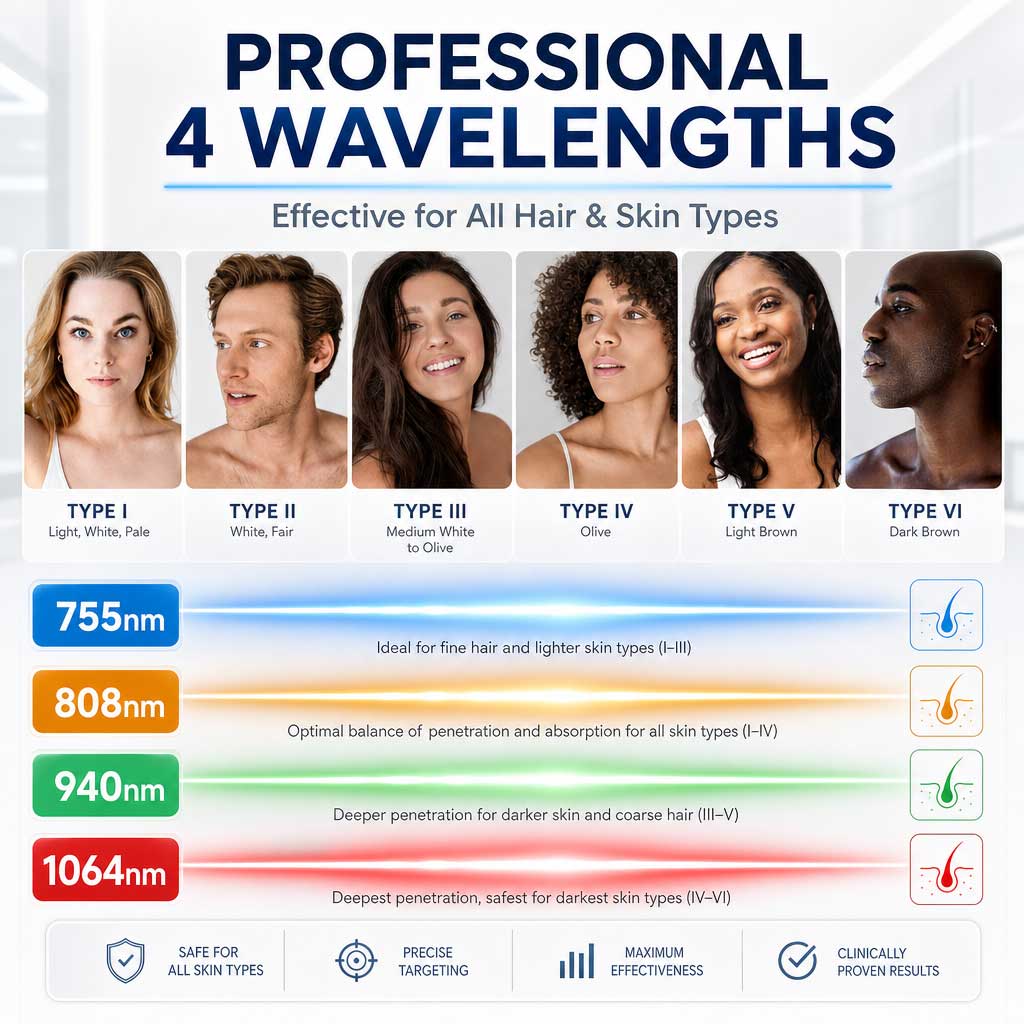
| Fitzpatrick type | Primary wavelength strategy | Parameter strategy | Safety focus |
|---|---|---|---|
| I-II (fair, burns easily) | 755 nm or 808 nm | Standard pulse durations; energy set by hair thickness and colour | Comfort and prevention of over-treatment on thin skin |
| III-IV (medium, tans readily) | 808 nm, with 755 nm or 940 nm as adjuncts | Conservative starting energy; test spot before full treatment | Cooling performance; monitoring for pigmentary change |
| V-VI (dark to deeply pigmented) | 1064 nm, with 940 nm where available | Longer pulse durations, lower energy density, emphasis on cooling and adequate intervals | Highest priority on epidermal protection; conservative progression; sun-exposure counselling |
Skin type is not the only variable. Hair colour, hair thickness, follicle depth, body area, and recent sun exposure all modify the plan. A test spot and an incremental approach remain good practice regardless of platform.
Hair Type, Depth and Body Area
- Coarse, dark hair responds to the widest range of wavelengths and typically needs fewer sessions than fine hair.
- Fine or light hair presents less melanin target, so efficiency matters more – making the strongly absorbed wavelengths useful where skin type permits.
- Deep follicles (as in some body areas) favour longer wavelengths with greater penetration.
- Curved and sensitive areas – face, bikini line, underarm – reward precise applicator placement and consistent cooling, since the applicator must maintain contact.
- Ingrown-prone and pseudofolliculitis-prone areas are a common clinical motivation for treatment in patients with darker skin, where wavelength and cooling strategy matter most.
Why Cooling Determines the Safe Treatment Window
Cooling is not a comfort feature – it is the technical enabler of treating darker skin. Semiconductor contact cooling (TEC) holds the epidermal temperature down while energy is delivered, which:
- Allows higher energy to reach the follicle without injuring the surface
- Reduces the pain response, which in turn allows the practitioner to complete proper coverage instead of under-treating
- Shortens the practical interval needed between passes and improves treatment consistency
- Extends the range of skin types a single clinic can treat safely
When evaluating a diode platform clinically, cooling performance and applicator contact quality deserve as much attention as the wavelength list.
Why Multi-Wavelength Platforms Change the Patient Mix
Clinically, a multi-wavelength platform (combining 755, 808, 940, and 1064 nm options) changes who can be treated in a standard clinic:
- Fair-skin patients can be treated efficiently on the strongly absorbed wavelengths.
- Medium and darker skin types can be treated on longer wavelengths with conservative, cooling-supported protocols – without referring them elsewhere.
- Mixed-treatment households – family members or friends with very different skin types – can be seen in the same clinic.
- Operators gain a clinical decision tree rather than a single fixed option, and can document wavelength rationale in the patient record.
For a clinic, wavelength coverage is therefore a patient-coverage decision as much as a technical specification.
Treatment Interval and Course Planning
- Interval: Sessions are typically spaced several weeks apart to allow treated follicles to clear and to capture hair in the active growth phase.
- Course length: Because only a proportion of follicles are in the active phase at any time, a course of multiple sessions is required for a durable reduction – the number varies with area, hair type, and hormonal factors.
- Maintenance: Periodic sessions manage the follicles that later enter a growth phase.
- Photoprotection: Advise patients to avoid sun exposure and tanning before and after treatment, particularly in pigment-prone skin, and to report any pigmentary change promptly.
Managing Pigmentary Risk and Complications
- Pre-treatment assessment: Determine Fitzpatrick type, recent sun exposure, and any history of pigmentary disorders such as melasma.
- Test spot: Standard practice before full treatment, especially in higher Fitzpatrick types.
- Conservative progression: Start below the maximum tolerated setting and increase according to response and tolerance.
- Cooling discipline: Never trade cooling performance for speed.
- Documentation: Record wavelength, settings, area treated, and patient response – this supports both safety and clinical improvement over the course.
Contraindications and Screening
- Recent sun exposure or tanning in the treatment area – defer
- Active infection, dermatitis, or broken skin in the area – defer
- Photosensitizing medication – review before treatment
- Pregnancy – standard deferral per practice protocol
- History of keloid scarring – assess risk
- Implanted electronic devices – assess suitability before treatment
- Realistic expectation setting: laser hair removal produces durable hair reduction, not permanent removal of every follicle
Clinical FAQ
Q: Which wavelength should a clinic buy first?
A: Start from your patient mix. A clinic serving predominantly darker skin types needs longer-wavelength capability with strong cooling; a multi-wavelength platform is the more flexible long-term purchase if the patient mix is mixed.
Q: Is a longer wavelength always safer?
A: It has a wider melanin-related safety margin, but safe treatment still depends on cooling, pulse duration, energy selection, and operator competence. The wavelength is one variable of several.
Q: Can patients with very dark skin be treated?
A: Yes, with a longer-wavelength strategy, conservative parameters, effective contact cooling, and careful monitoring. Experience and correct device selection matter.
Q: Do I need to switch wavelengths mid-course?
A: Not routinely. Wavelength selection reflects the patient’s skin and hair characteristics and is normally set at assessment; changes are clinical decisions documented in the record.
Q: Why do some patients need more sessions?
A: Hair growth cycles, hair colour, follicle depth, area, and hormonal factors all influence response. Fine or light hair typically needs more sessions than coarse dark hair.
Q: How important is applicator contact?
A: Critical. Inconsistent contact means inconsistent energy delivery and inconsistent cooling – the most common avoidable cause of uneven results.
Q: Can hair removal be combined with other treatments?
A: It is frequently combined in body programmes, and skin-rejuvenation protocols are also offered on some platforms at separate settings. Sequencing and intervals are clinical decisions.
Q: What should be documented per session?
A: Wavelength used, settings, area, number of passes, cooling status, patient tolerance, and any adverse response.
Q: How do I set patient expectations?
A: Speak in terms of durable hair reduction over a course, not permanent removal of all hair, and explain the interval schedule at consultation.
Q: How does skin type affect pricing and scheduling?
A: Higher Fitzpatrick types usually warrant conservative settings and closer monitoring, which can affect session planning – worth reflecting in the treatment plan discussion.
Q: What certification should the platform carry?
A: ISO 13485 quality management and MDSAP compliance, with product compliance aligned to CE, FDA, and TGA frameworks for market registration in your territory.
Q: What training is needed?
A: Training on Fitzpatrick assessment, wavelength and parameter selection, cooling management, and complication recognition. Local regulation determines who may perform laser hair removal.