
Quick Answers
- What does a fractional CO2 service require beyond the device? A controllable room, plume capture at the handpiece, wavelength-correct eye protection, an anesthesia pathway inside your legal scope, and written aftercare and complication protocols.
- Is laser plume a real clinical concern? Yes. Ablative resurfacing produces a plume carrying particulate matter and potentially viable cellular material, so capture is a standard control, not an accessory.
- Can a fractional CO2 laser share a room with other devices? Only if the room can be cleared and ventilated, the laser is locked out between users, and reflective and flammable materials are managed consistently.
- What most often derails a new resurfacing service? Capacity planning that ignores healing time – filling the schedule as if patients could be treated weekly when recovery sets the real cadence.
- How should a buyer judge a manufacturer? By whether documentation supports safe operation: specifications, IFU, depth and density training, service and calibration arrangements, and quality-system evidence such as ISO 13485 and MDSAP.
Why Ablative Resurfacing Is an Operating Discipline, Not Just a Device Purchase
Most fractional CO2 content reads as if the decision ends when the machine arrives. In practice, arrival is when a clinic acquires a set of obligations: a room that behaves predictably, air that is managed, eyes that are protected, anesthesia that is legally administered, patients prepared for a week of visible healing, and records showing every control was in place.
This is not a compliance ritual. It is the difference between a service that runs for years and one that produces a single memorable complication and quietly stops taking bookings. Ablative fractional CO2 is useful, but it is the most operationally demanding device in a typical aesthetic portfolio. What follows is that demand, described as something a buyer can price, staff and audit before ordering.
Why Ablative Depth Sets the Safety Envelope
Fractional CO2 uses a 10,600 nm wavelength strongly absorbed by water, which is why tissue is removed rather than simply heated. The scanner divides the beam into micro-columns, each creating a narrow zone of ablation ringed by controlled thermal injury; untreated skin between columns supports re-epithelialisation. A quotable definition: fractional CO2 resurfacing is a controlled, pattern-based partial-thickness injury in which depth, density and pulse characteristics determine both the clinical effect and the healing burden.
Everything in an operations plan derives from that sentence. The injury is partial-thickness and ablative, so healing is visible and staged: oozing and crusting, re-epithelialisation, then prolonged erythema while remodelling continues. It is thermal as well as ablative, so pigmentary response and infection risk stay live. And it is pattern-based, so the same device runs conservatively or aggressively – which makes operator decisions, not hardware, the dominant variable.
Room Requirements: What a Fractional CO2 Service Actually Needs
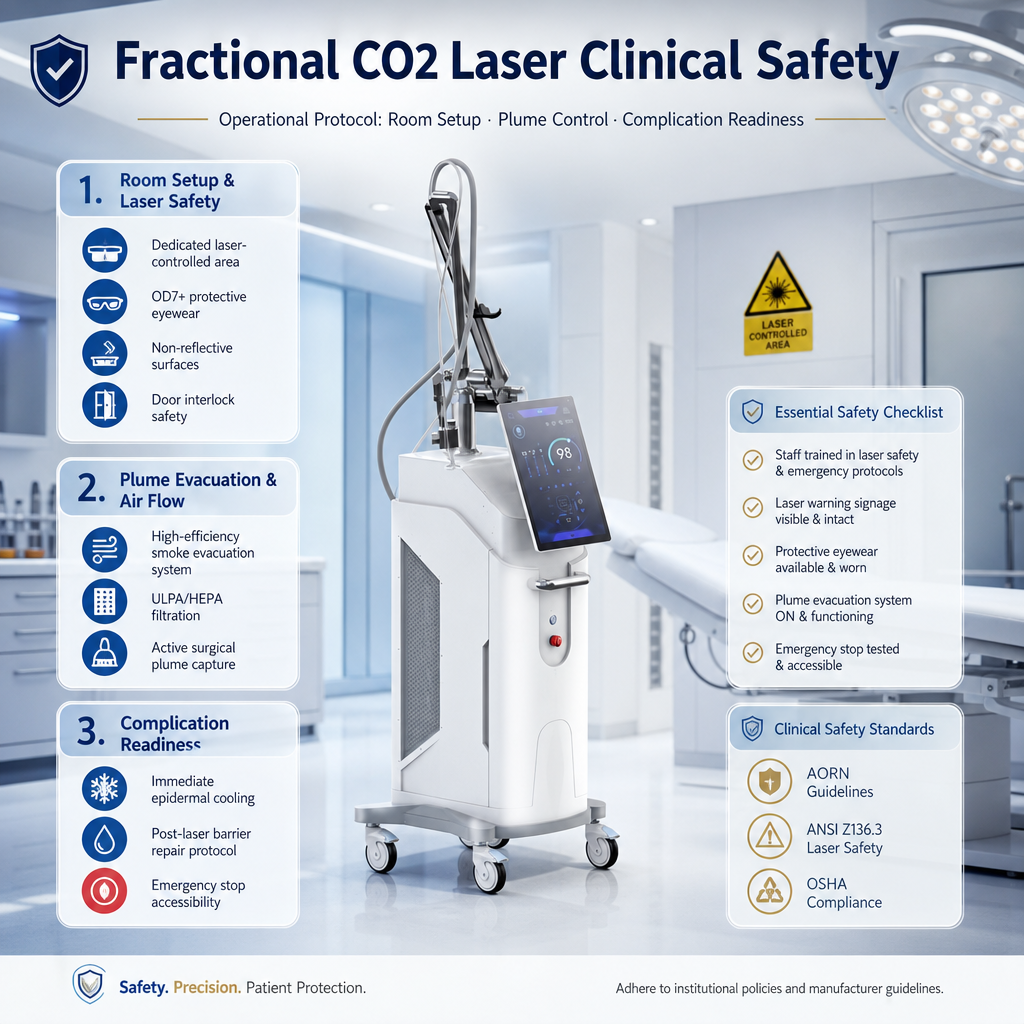
The room need not be large, but it must be controllable:
- Controllable access. A door that closes and a policy on who enters during emission. Ablative sessions are no place for observers without eye protection.
- Non-reflective surfaces. Matte worktops, no uncovered mirrors or polished metal in the beam path. Specular reflection is the most avoidable eye hazard in laser rooms.
- Air that can be moved. Local exhaust at the handpiece plus general ventilation, with a defined air-change routine and filtration replaced on schedule.
- Anesthesia-ready setup. An adjustable bed, a trolley for topicals and block supplies where scope permits, and resuscitation equipment within reach per local requirements.
- Post-treatment space. Room for cooling, dressing and a calm exit, because the first thirty minutes set expectations for the whole course.
- Lockout and signage. Door signage, key or code control, and a written rule that the device is disabled when the room is used for anything else.
Laser Plume and Air Quality: The Most Underestimated Control
Ablative resurfacing vaporises tissue, and what leaves the skin is a plume of particulate matter, water vapour, gases and potentially viable cellular material. The surgical control hierarchy applies directly: capture at the point of generation, filter, then ventilate as a secondary measure. A wall extractor across the room is not capture – by the time plume reaches it, staff have breathed it.
Operationally that means a dedicated smoke evacuator with the nozzle held at the handpiece, filtration suited to the system, and a change schedule tied to hours of use. It also means habits: nozzle kept close rather than clipped to the trolley, emission paused while the operator repositions, and no assumption that the evacuator replaces room ventilation. Where the clinic’s risk assessment calls for respiratory protection, it must be fitted, stocked and used consistently.
The commercial point is easy to miss: plume control is a recurring cost and a workflow constraint. It belongs in the cost-per-session model beside consumables and room time.
Ocular Protection and Fire Risk: Two Controls That Cannot Be Improvised
Eye protection for a 10,600 nm beam is not interchangeable with diode or IPL eyewear. Wavelength-specific filters in the correct optical density are required, and they must fit. Patients need shields or goggles appropriate to the area, including periorbital work where the eye is protected while surrounding skin is treated. Staff eyewear should be issued personally, inspected and replaced when scratched; a shared box of mismatched glasses is a finding waiting to be written up.
Fire risk comes from three directions: flammable skin preparations, oxygen-enriched atmospheres, and alcohol or paper near the handpiece. The controls are unglamorous and effective – let preparation dry fully, keep alcohol out of the immediate field, keep a water-based extinguisher and moistened gauze within reach, and brief the team on what to do if a spot ignites. Clinics that treat a high-energy ablative device as “just another facial” discover these problems inconveniently.
Anesthesia and Comfort Pathways Within Your Scope of Practice
Ablative fractional CO2 is comfortable enough for topical anesthesia in many facial protocols, but not all. Depth, density, area treated in one session and patient anxiety shift the requirement, so the anesthesia plan is part of the treatment plan rather than an afterthought.
Settle three questions before the first booking. Which options are permitted for which staff member locally – topical, infiltration, nerve blocks and sedation carry different rules that vary by market. What monitoring and emergency equipment the chosen pathway requires. And how the clinic handles a patient who cannot tolerate the planned depth: step density down, split the area across sessions, or reschedule. Clinics that answer the third question in advance avoid the commonest compromise in resurfacing – pushing through a painful session and producing a deeper injury than planned.
Operational Comparison: Facility and Control Burden by Modality
The comparison that matters when planning rooms and staff is not which device is stronger, but what each demands of the facility.
| Operational factor | Fractional CO2 (ablative) | Non-ablative fractional | RF microneedling |
|---|---|---|---|
| Plume generation | Substantial; capture at handpiece expected | Limited | Minimal |
| Ocular protection | Wavelength-specific eyewear plus patient shielding | Wavelength-specific eyewear | Standard clinic PPE |
| Skin barrier after session | Open, with crusting; infection control focus | Intact | Punctate, closes quickly |
| Anesthesia | Often topical, sometimes infiltrative by depth and area | Typically topical | Typically topical |
| Room suitability | Dedicated or lockable, ventilated, non-reflective | General treatment room | General treatment room |
| Scheduling constraint | Set by epithelial healing; visible downtime | Minimal | Short |
| Consumable profile | Lower consumable cost, higher room and staff time | Moderate | Single-use cartridges dominate |
Read across the rows and the point is clear: an ablative platform anchors a resurfacing programme rather than replacing a lunchtime device, and works best paired with a short-downtime modality for patients who cannot accept a week of healing.
Specification-to-Safety Mapping
| Feature | Advantage | Benefit |
|---|---|---|
| Adjustable depth and density | Injury tuned to indication, area and skin behaviour | Patient: treatment matched to concern. Clinic: fewer protocol compromises and a defensible record of settings |
| Stable, verifiable output | Session-to-session consistency | Patient: predictable healing. Clinic: outcomes can be compared and audited |
| Pattern and scan control | Even coverage with defined untreated tissue between columns | Patient: more uniform healing. Clinic: fewer operator-dependent variations |
| Cooling or cooled airflow | Comfort support during emission | Patient: better tolerance. Clinic: fewer aborted sessions |
| Hardware interlocks and key control | Emission only under intended conditions | Patient: reduced accidental exposure. Clinic: a demonstrable control at inspection |
| Parameter storage and records | Settings retrievable for review and repeat | Patient: continuity across sessions. Clinic: documentation for complication review |
| Serviceable sealed optical path | Contamination and misalignment less likely | Patient: consistent energy delivery. Clinic: lower unplanned downtime |
Consumables, Room Time and Cost per Session
Ablative resurfacing has an unusual cost structure: consumables are modest, while room time, staff time and filtration dominate. Build the model from your own local figures:
- Consumables: topical anesthetic, dressings, cooling supplies, aftercare kit, cleaning materials, filters amortised per session.
- Room and equipment time: treatment slot plus set-up, cleaning and turnaround.
- Staff time: operator plus assistant for a full-face session, and the preceding consultation.
- Service reserve: annual calibration, optical service and parts, divided by expected sessions.
- Complication reserve: review visits and aftercare support, a real line item in any ablative service.
Divide by realistic session volume, not a fully booked best month. Services priced on best-case throughput usually discover their true cost after the first quiet quarter.
Scheduling Around Healing: Throughput Without Guesswork
The constraint is not room availability but the patient’s healing calendar and their willingness to be seen healing. So treat the course as a sequence with defined review points, agreeing the next date at each session and deciding whether to proceed once epithelial recovery can actually be assessed. And plan the year, not the week: demand clusters when patients can accept visible downtime and falls away when they cannot, so a clinic that maps its calendar fills deep-treatment slots in the right months and lets short-downtime modalities carry the others.
Complication Readiness: Recognition, Escalation and Records
No protocol removes complications; it determines how fast they are recognised and how well they are handled. Four categories cover most of what a resurfacing service will see.
- Delayed re-epithelialisation. Prolonged crusting or a wound that will not close warrants review, wound-care adjustment and a lower-energy plan next time.
- Infection. Increasing pain, spreading erythema, purulence or fever is a medical review, not a cosmetic one; agree the referral route in advance.
- Pigmentary change. Managed with photoprotection, patience and revised depth and density – the point is detecting it at review, not after the course ends.
- Scarring or contour irregularity. Unusual induration or textural change should trigger early reassessment, not further treatment.
The records that make this work are simple: standardised photographs at fixed intervals and lighting, exact settings per zone, the anesthesia pathway, aftercare issued, and every review with its outcome. In a dispute, a clinic holding this file stands in a very different position from one reconstructing events from memory.
Why Manufacturer Documentation Matters for Safe Operation
Safety controls depend on information the manufacturer supplies, which is why the quality system behind a device is a clinical issue rather than a procurement checkbox. JT MED devices are manufactured by Beijing JONTELASER Technology Co., Ltd., established in 2004 and exporting professional medical aesthetic equipment to more than 50 countries. Manufacturing operates under ISO 13485 quality management with MDSAP participation, and product compliance is aligned to CE, FDA and TGA frameworks, with regulatory documentation provided to support local registration.
For a resurfacing buyer the documents that matter are the specification sheet, the IFU with depth and density guidance, factory test reports, the service and calibration schedule, and training covering complication recognition as well as technique. JT MED supplies operator training, marketing support and after-sales service alongside OEM/ODM programmes. Where local registration is required, request the regulatory file at quotation stage – it sets the launch date.
FAQ
Does fractional CO2 need a dedicated room?
A dedicated room is ideal; a lockable, ventilated, non-reflective room used only for device treatments is workable. A shared space where plume cannot be captured is not.
Why is plume control treated as mandatory?
Ablative emission produces particulate and potentially viable material. Capture at the handpiece, filtration and ventilation are standard controls protecting staff as much as patients.
What eye protection is required?
Wavelength-specific eyewear in the correct optical density for everyone in the room during emission, plus patient shielding near the eyes. Diode or IPL eyewear is not a substitute.
Who may perform ablative resurfacing?
Local regulation and professional scope decide this, and it varies widely between markets. Confirm the position for your jurisdiction before marketing, and record staff competency.
Can a nurse or therapist handle anesthesia?
Only within locally permitted scope. Topical, infiltration and sedation are three different privileges with different supervision rules; the protocol should state who may do which.
What fire precautions are realistic in a small clinic?
Let skin preparation dry fully, keep alcohol and paper away from the field, keep a water-based extinguisher and moistened gauze within reach, and brief the team on ignition response.
How should the room be cleaned between patients?
Follow the IFU for handpiece and optics, use compatible disinfectants on surfaces, replace plume filtration on schedule, and document the routine so it can be evidenced.
What should be recorded per session?
Zones, depth and density settings, anesthesia used, aftercare issued, interval photographs, and the outcome at each review – supporting continuity of care and later complication review.
How quickly should a complication be escalated?
Immediately for infection signs, severe pain or an eye exposure incident; at the next review for delayed healing or early pigmentary change. Name the route in the protocol.
What servicing keeps output consistent?
Follow the manufacturer’s calibration and optical service interval, log output checks, and verify the device before treating again if clinical response changes unexplainedly.
Do I need consumables beyond anesthesia and dressings?
Plan for topical products, dressings, cooling supplies, aftercare kits, cleaning materials and plume filters. Modest per session, but they belong in the cost model from day one.
How does this affect pricing and booking?
Price the full slot – consultation, treatment, cleaning, turnover – rather than emission time, and book courses with review points so healing, not optimism, sets the next date.
Summary
Fractional CO2 remains one of the most capable resurfacing technologies a clinic can hold, and the one that most rewards preparation. The device delivers a controlled partial-thickness injury; the clinic decides whether the environment around that injury is controlled too. Rooms that can be cleared and ventilated, plume captured where it is generated, wavelength-correct eye protection for everyone present, anesthesia inside a defined scope, schedules built on healing rather than hope, and records showing exactly what was done – these turn a powerful platform into a durable service line. Buyers who judge a supplier on documentation and training rather than specification sheets alone tend to be the ones still running the service three years later.
JT MED (Beijing JONTELASER Technology Co., Ltd.) manufactures professional medical aesthetic devices under ISO 13485 quality management with MDSAP participation, exporting to more than 50 countries since 2004. Request the fractional CO2 specification sheet, IFU summary, clinical protocol guidance and training materials from the JT MED export team, and ask for the regulatory documentation required in your market.