
Terminal Age HIFU Machine: Four-Frequency Linear + Dot Delivery for Clinical Buyers
Quick Answers
- What separates this platform from a standard HIFU unit? It pairs two energy-delivery geometries – Linear and Dot – with four selectable frequencies, so delivery pattern and depth are chosen per treatment zone rather than fixed for the whole face.
- How does a practitioner choose between Linear and Dot? Dot delivery concentrates energy into discrete points for focal work along a defined lifting vector; Linear delivery distributes energy along a line for broader regional contraction. The two are planned together for each zone.
- What does four-frequency selection change in practice? Depth options. Tissue thickness, zone and laxity pattern differ between patients, and depth selection is the variable that determines whether energy reaches the structure you intended.
- What is the treatment experience for the patient? Non-invasive delivery with no incisions, needles or anaesthesia, and return to normal activity the same day. Transient warmth, redness or tenderness can occur.
- Who is not a suitable candidate? Patients with advanced laxity expecting surgical-grade repositioning, and any patient with a contraindication under the device instructions for use or local regulatory requirements.
What the Dual Delivery System Does
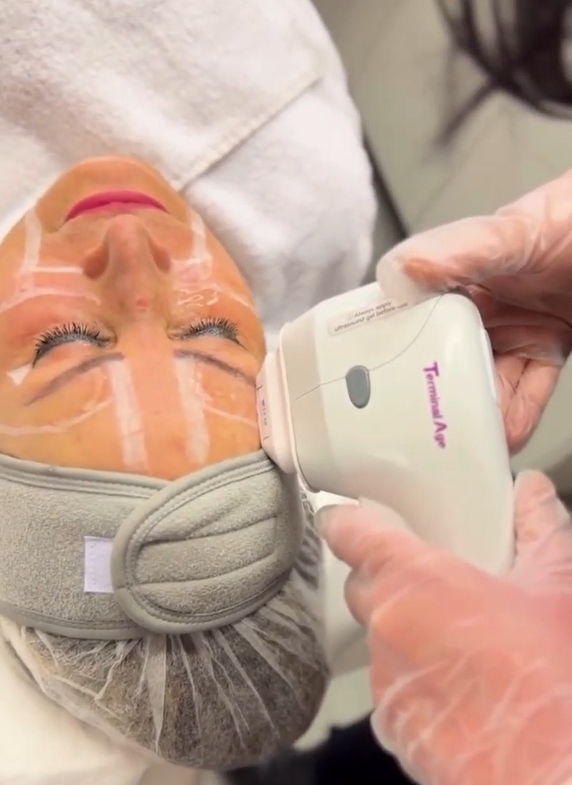
Focused ultrasound works beneath an intact skin surface. Energy is concentrated at a selected focal depth, producing small thermal coagulation points in the target layer while the tissue above is spared. That is why the procedure needs no wound and no recovery period – and why depth selection, not raw output, is the variable that decides the clinical outcome.
The Terminal Age HIFU Machine adds a second variable: energy geometry. Dot delivery places energy as discrete points, which suits focal support along a specific vector such as the jawline. Linear delivery spreads energy along a continuous line, which suits broader contraction across an area such as the cheek and mid-face. Because laxity is rarely uniform, a plan that uses both geometries matches the treatment to the zone instead of compromising on one pattern for the whole face.
Collagen contraction begins with the thermal effect itself, and the remodelling response that follows develops over subsequent weeks and months. This is why patients are counselled that improvement is progressive rather than immediate.
Reading the Specification Against Clinical Intent
| Specification | What it enables clinically | What to verify with the supplier |
|---|---|---|
| Linear + Dot delivery | Focal anchoring plus regional contraction within one session plan | How mode selection is documented in the treatment protocol |
| Four selectable frequencies | Depth options matched to zone and tissue thickness | Which indications each setting is intended for, per the IFU |
| Digital energy control | Stable output across a treatment pass and repeatable parameters between sessions | Whether parameters can be stored and recalled per patient |
| Handle range (face, periorbital, body) | Extended treatment menu from a single platform | Which handles are included as standard and which are optional |
| Non-invasive delivery | No incisions, no sutures, no downtime | Documented aftercare and adverse-event guidance |
Consistency and Documentation in Multi-Operator Clinics
Two patients rarely receive identical parameters, but each patient should receive consistent energy across the whole treatment area. Digital energy control addresses both sides of that requirement: output stays stable through a pass so the end of the treatment matches the beginning, and stored parameters make a follow-up session reproducible rather than reconstructed from memory.
For clinics running more than one practitioner, this is an operational question as much as a technical one. Repeatable parameters reduce variability between operators, and recorded protocols make it possible to review what was actually delivered when a patient returns for assessment. Ask any supplier how parameters are saved and exported before you commit to a platform – it is one of the few features that directly affects day-to-day consistency.
Positioning: Which Tool for Which Clinical Goal
| Clinical goal | Primary modality | Why |
|---|---|---|
| Lifting and tightening without downtime | HIFU (Linear + Dot) | Focused energy reaches support layers beneath intact skin |
| Skin texture, pores and acne scarring | RF microneedling | Needle-delivered radiofrequency remodels dermal tissue |
| Pigment and tattoo clearance | Q-switched laser | Selective absorption targets pigment, not tissue support |
| Resurfacing and scar revision | CO2 fractional laser | Ablative resurfacing with a defined recovery period |
| Mild laxity maintenance | HIFU at maintenance intervals | Non-invasive, repeatable, no surgical risk |
| Advanced tissue descent | Surgical referral | Energy devices do not reproduce surgical repositioning |
Positioning HIFU honestly against these alternatives is commercially sound as well as clinically correct. A clinic that overstates a device’s range loses credibility at the consultation stage, where patients compare what they were promised against what they can see.
Deployment Checklist Before Your First HIFU Patient
- Confirm market documentation. Verify certification and registration paperwork against your own market’s requirements before the device ships, not after it arrives.
- Complete operator training. Confirm who delivers training, in what format, and whether it covers mode selection and zone planning rather than device operation alone.
- Build the protocol library. Define your standard plans per zone so parameters are chosen deliberately rather than accumulated by trial and error.
- Set patient selection criteria. Agree in advance which presentations you treat, which you combine with other modalities, and which you refer for surgical assessment.
- Prepare consent and aftercare documents. Include what the treatment does, what it does not do, expected progression, and what aftercare the patient should follow.
- Plan the consultation. Record baseline photography and assess laxity pattern so the treatment plan is justified and the outcome is reviewable.
- Define maintenance intervals. Set review points by response rather than by a fixed calendar, so the rebooking conversation has a clinical basis.
- Confirm consumables and service. Check handle and consumable availability, warranty terms, and how service requests are routed for your region.
Manufacturing and Compliance Background
The Terminal Age HIFU Machine is manufactured by Beijing JONTELASER Technology Co., Ltd. and marketed under the JT MED brand. The company was founded in 2004 and exports to more than 50 countries, operates an ISO 13485 certified quality system with MDSAP participation, and aligns device compliance with CE, FDA and TGA frameworks. Support for clinic buyers includes device training, OEM/ODM options, marketing materials and after-sales service.
Buyers in regulated markets should treat the credential documents themselves, not the marketing summary, as the reference point: check which certificates apply to your market, what registration pathway you need, and which documents the manufacturer will provide to support it.
Patient Selection and Expectation Setting
The candidates who report the highest satisfaction tend to be those with mild to moderate laxity who want visible improvement without surgery, and those who are deliberately postponing or avoiding a surgical procedure. Patients with advanced tissue descent are better served by a surgical referral, and patients whose primary concern is texture, pigment or volume loss need a different modality in the plan.
Counsel patients that collagen remodelling is progressive, that maintenance sessions are part of the plan rather than an upsell, and that no energy-based platform reproduces surgical repositioning. Setting that expectation at consultation is what makes the review appointment straightforward.
Frequently Asked Questions
How does a practitioner decide which frequency to use? Selection follows the zone being treated and the depth of the structure being targeted, within the settings the device’s instructions for use specify for that indication.
Can Linear and Dot delivery be used in the same session? Yes – that is the design intent. The two geometries address focal and regional tightening respectively, and are planned per zone within one treatment.
Is there any downtime? No incisions are made, so patients typically return to normal activity the same day. Transient redness or tenderness is possible.
How soon are results visible? Some tightening is often reported early, while the collagen remodelling response develops over the following weeks and months.
Is it equivalent to a facelift? No. It is a non-surgical option for suitable candidates and does not reproduce surgical repositioning of tissue.
Can it be combined with other treatments? Yes. Lifting and dermal remodelling address different layers, and sequencing is decided by the treating practitioner.
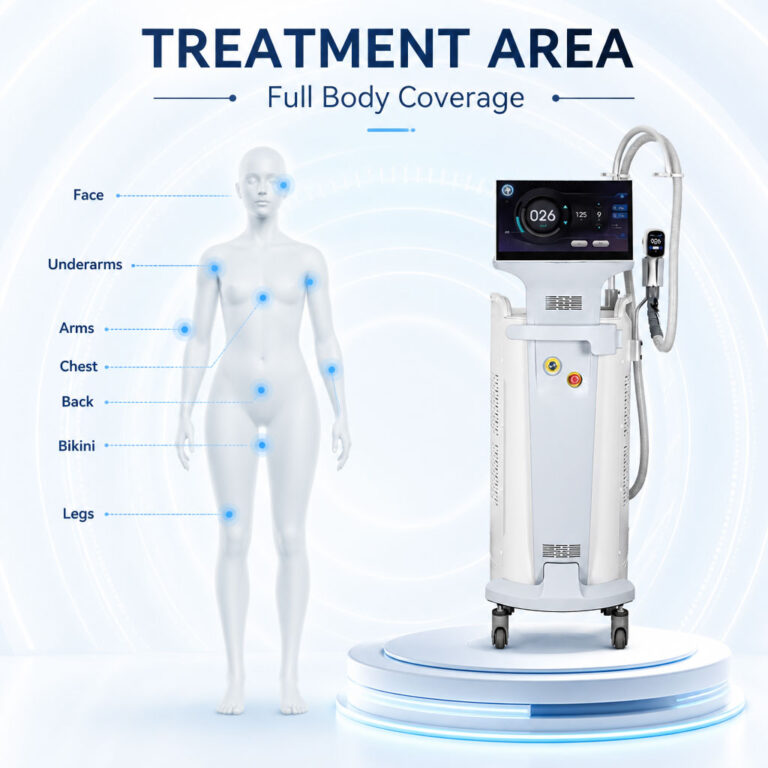
Can it treat areas beyond the face? The handle range supports facial and body applications; the protocol for each area is set by the practitioner.
What documentation should a buyer request? Certification relevant to your market, the instructions for use, training scope, consumable and spare-part lists, and warranty and service terms.
What training comes with the device? Training scope varies by supplier and region – confirm the format, who delivers it, and whether protocol building is included.
What maintenance does the platform require? Follow the maintenance schedule in the instructions for use, and confirm how service is routed in your country before purchase.
Is it suitable for all skin types? Suitability is determined by the treating practitioner under the IFU and local requirements; consultation assessment and contraindication screening apply in every case.
What should a demo cover? Mode selection, frequency selection for a named indication, parameter storage, and how the training materials support protocol building in your clinic.
Next Step
Contact the JT MED export team for the Terminal Age HIFU Machine specification sheet, the certification documents relevant to your market, and details of the operator training programme.